As the former Director of Communications at the Cambridge Police Department, I experience firsthand the rapid series of events and the power that social media had on effectively dispelling information to the public. Below, I share how social media brought the city together when they needed it most.
One of the first things I did when I joined with the Cambridge Police Department in 2010 was build their online presence on Twitter and Facebook. While this was mostly uncharted waters for police departments at that time, I wanted to find a way to quickly and directly communicate with city residents who were interested in news and information from our department.
The Boston Police had been a leader in the social media arena for some time and was one of the departments I tried to emulate when getting started in Cambridge. For three years, I updated the Cambridge Police accounts regularly and gained a respectable following of about 3,500 on Twitter. To spice things up, we developed an automated, real-time tweets system that updated followers 24/7 about serious crimes that were occurring in Cambridge. We launched this innovative system in February of 2013, and within weeks the department’s Twitter following had doubled to over 7,000.
When the Boston Marathon bombing occurred, people began looking anywhere they could for information. Unfortunately, updates were slow to come from traditional media – most of whom had camped out in Boston and were broadcasting around the clock – and when they did come, the information was often misleading or just plain inaccurate.
Many in Boston (and around the globe) turned to social media for their information. When the chaos crossed over the bridge and into Cambridge, our Twitter followers doubled to 15,000 within a 48-hour period. As the only person able to update the Cambridge Police Department account, I immediately had a powerful tool at my fingertips to share official information to a hungry public.
Much has been written about the power of social media information sharing during a crisis, and a recent report by the Harvard University Kennedy School of Government concluded that the Boston Police Department’s use of Twitter during last year’s tragedy “demonstrated the level of trust and interaction that a department and a community can attain online.”
The side that has not yet been explored is the side I witnessed: social media’s power to help people heal and feel connected to those who can often seem unemotional, distant, and intimidating. The flood of messages offering support and thanks, the food and cards that were sent the station, and the well wishes directed toward the officers and the department were indescribable.
I turned to the Cambridge Police Department’s social media accounts to reach out to people who had sent thanks or dropped off food to let them know how thankful we were for their gestures. Although it was a small thing, I felt it was my duty on behalf of the department to reach out to the individuals, particularly because it was not possible for the officers to do so. We shared photos of the food, flowers, and cards that were dropped off, making people feel connected to those they so badly wanted to support.
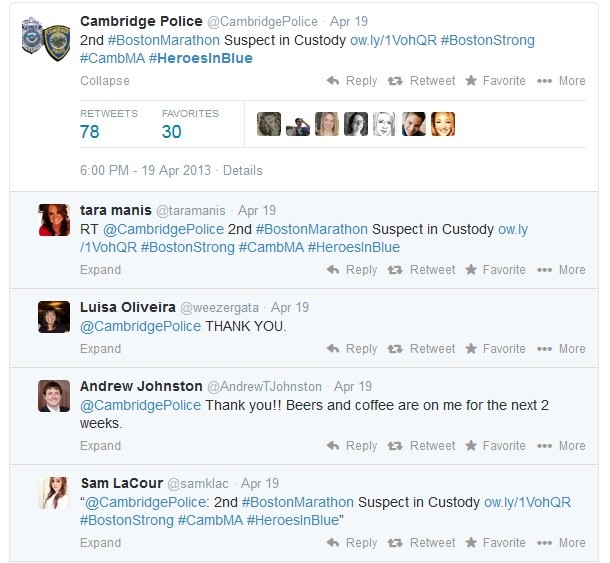
After the remaining bombing suspect was caught after a day-long search in Watertown, I jumped on the @CambridgePolice Twitter account to announce the news:

Even though I worked for the police and was a part of their team, I felt like something more needed to be expressed. Not knowing what to do or how to express it, I fired off another tweet with a few taps of my finger on my iPhone and created a lasting hashtag to thank those who protect us every day:
The above tweet is the most successful social media post I have ever created, with over 1,500 retweets. I was proud to be a member of the Cambridge Police Department then, and I am proud to say I was part of their team during those difficult days and weeks.
April 18th marks the one-year anniversary since Massachusetts Institute of Technology (MIT) Police Officer Sean Collier was murdered while on patrol on the MIT campus in Cambridge. I was honored to be able to attend his memorial service at MIT last year, and I can’t help but reflect back to how social media once again helped people express their thanks and feel connected to a man they never knew.
I live-tweeted the event from the @CambridgePolice Twitter account to allow people who couldn’t attend to feel connected and reach out in some way. So many tweets contained the hashtag #CollierStrong, and it’s my hope that this hashtag continues on this year as a lasting testament to Officer Collier and his bravery.
In a world where so many people feel disconnected by technology, I believe its true power is best realized when it helps to connect people to grieve, thank, and support each other in times of need.
 Riviello Communications