A firsthand account of what it took to run an emergency shelter for five days during and after Winter Storm Hernando in Provincetown, Massachusetts.
By the early morning hours of Monday, February 23, 2026, Blizzard Hernando was pummeling Provincetown and the entirety of Cape Cod.
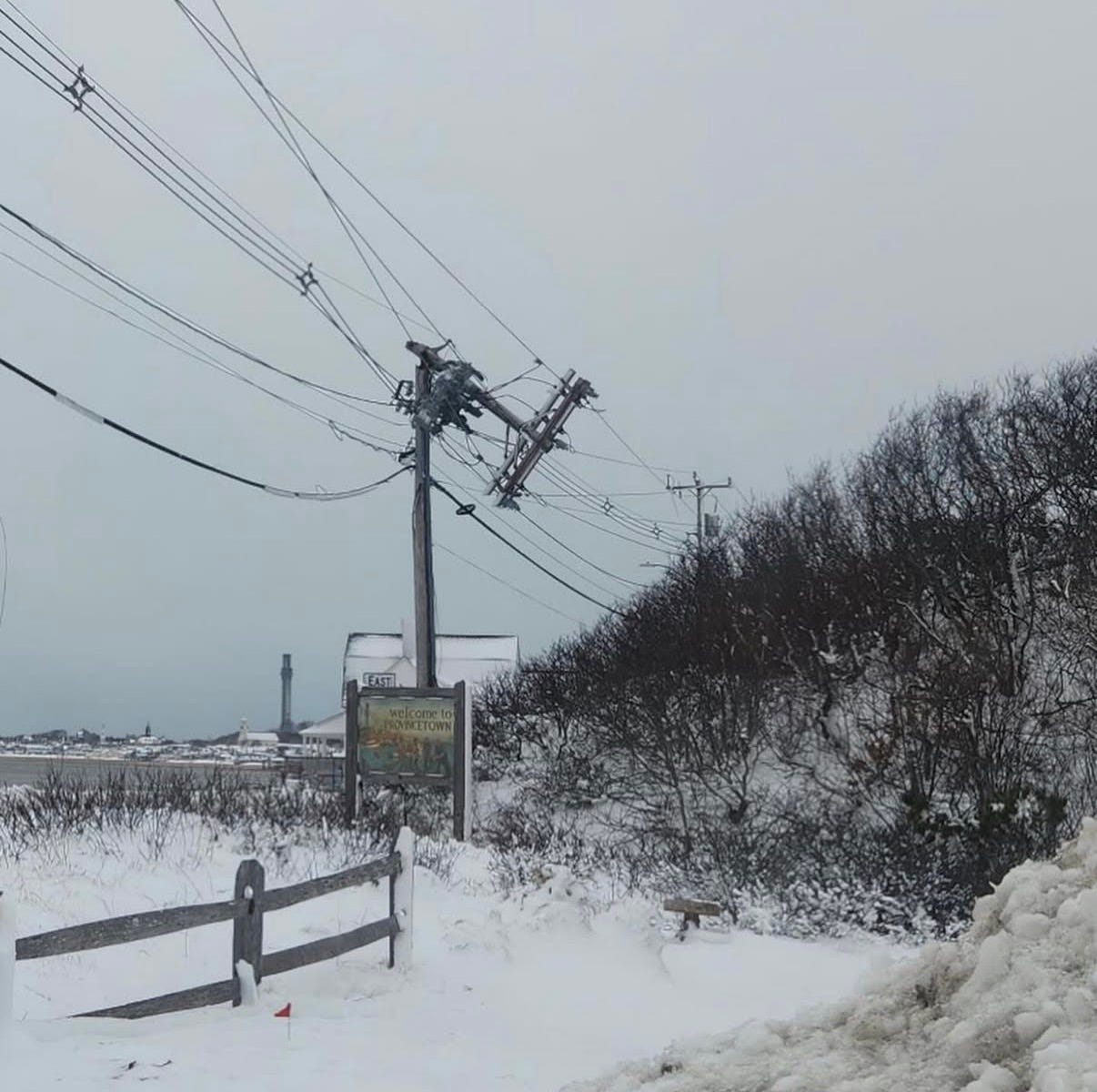
This was not some routine winter storm — it brought sustained blizzard conditions to the Outer Cape, with temperatures hovering in the teens and 20s for many hours, 12”+ of heavy, wet snow, and wind gusts approaching hurricane force. White-out conditions persisted for hours at a time as snow fell at rates of one to two inches per hour, while 70–90 mph gusts brought down trees and power lines, snapped poles, and buried freshly plowed roads almost as quickly as they were cleared.
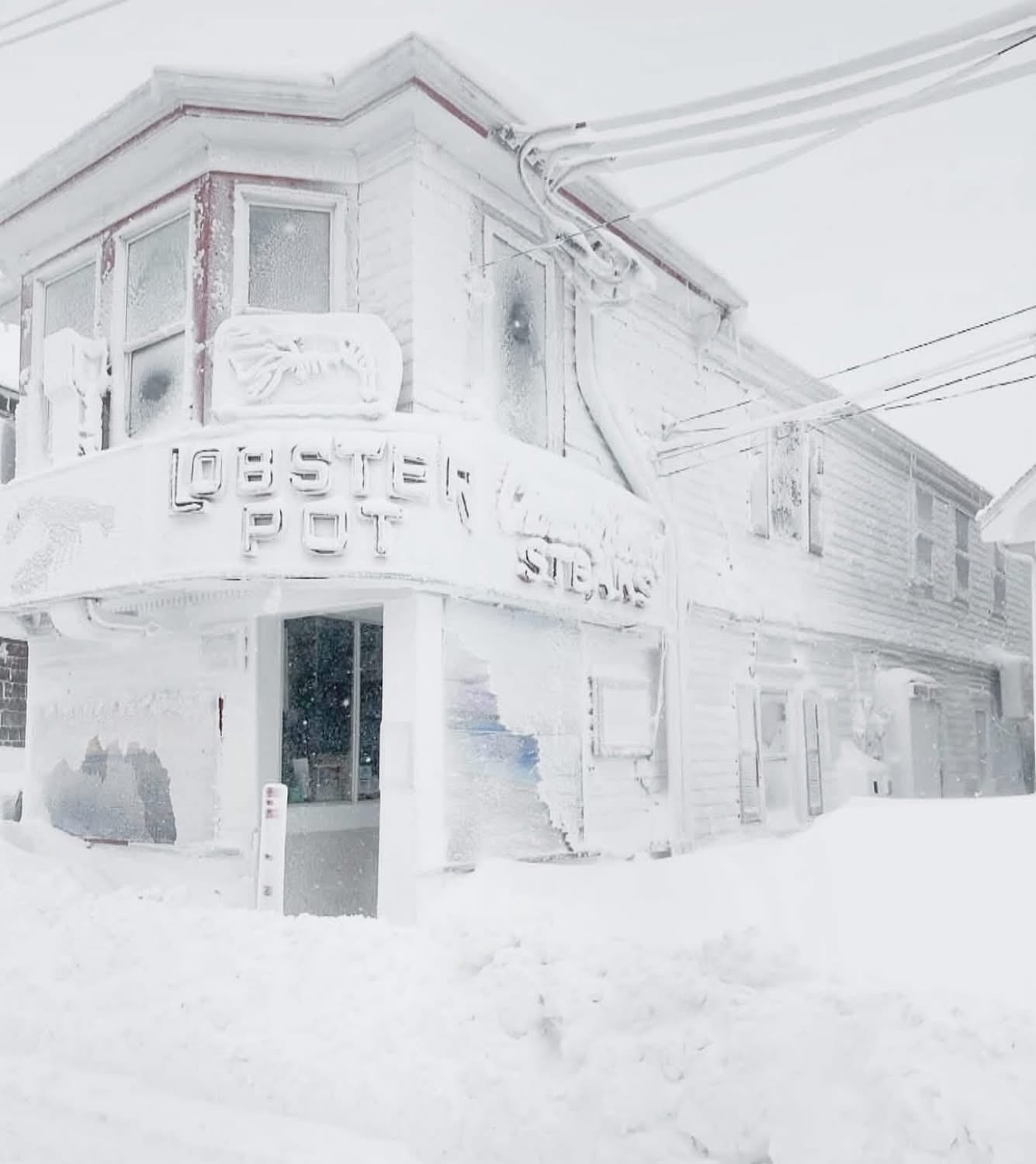
If you weren’t here, it’s hard to articulate what it feels like to be at the very end of the road — geographically isolated on a clear day — and then watch, almost in real time, as the physical systems that connect you to the rest of the world begin to fail. The wind intensifies. The lights go out. The snow accumulates faster than it can be cleared. And you begin doing the quiet math in your head about how long this might last and how many people are going to need help.
I’m writing this because I think it’s important to memorialize what happened — not just the timeline, but the experience of it. The decisions we made with imperfect information. The moments where plans bent, cracked, and had to be rebuilt. The exhaustion. The pride. The weight of responsibility. And the extraordinary effort of a small (but incredibly committed) group of Town staff who showed up in ways that very few people outside of our shelter building will ever fully understand.
6:00 a.m. Monday, February 23
By 6:00 a.m., my power was out, as was 100% of the power in town.
By 10:00 a.m., the Provincetown Police Department had picked me up from my cold, dark condo and drove me through blowing snow to the Emergency Operations Center at the police station, where I would remain embedded for the next several hours. That drive alone was instructive. Visibility was poor. Snow was drifting unpredictably. You could feel that this was not going to be a quick “plow and restore” type of event.
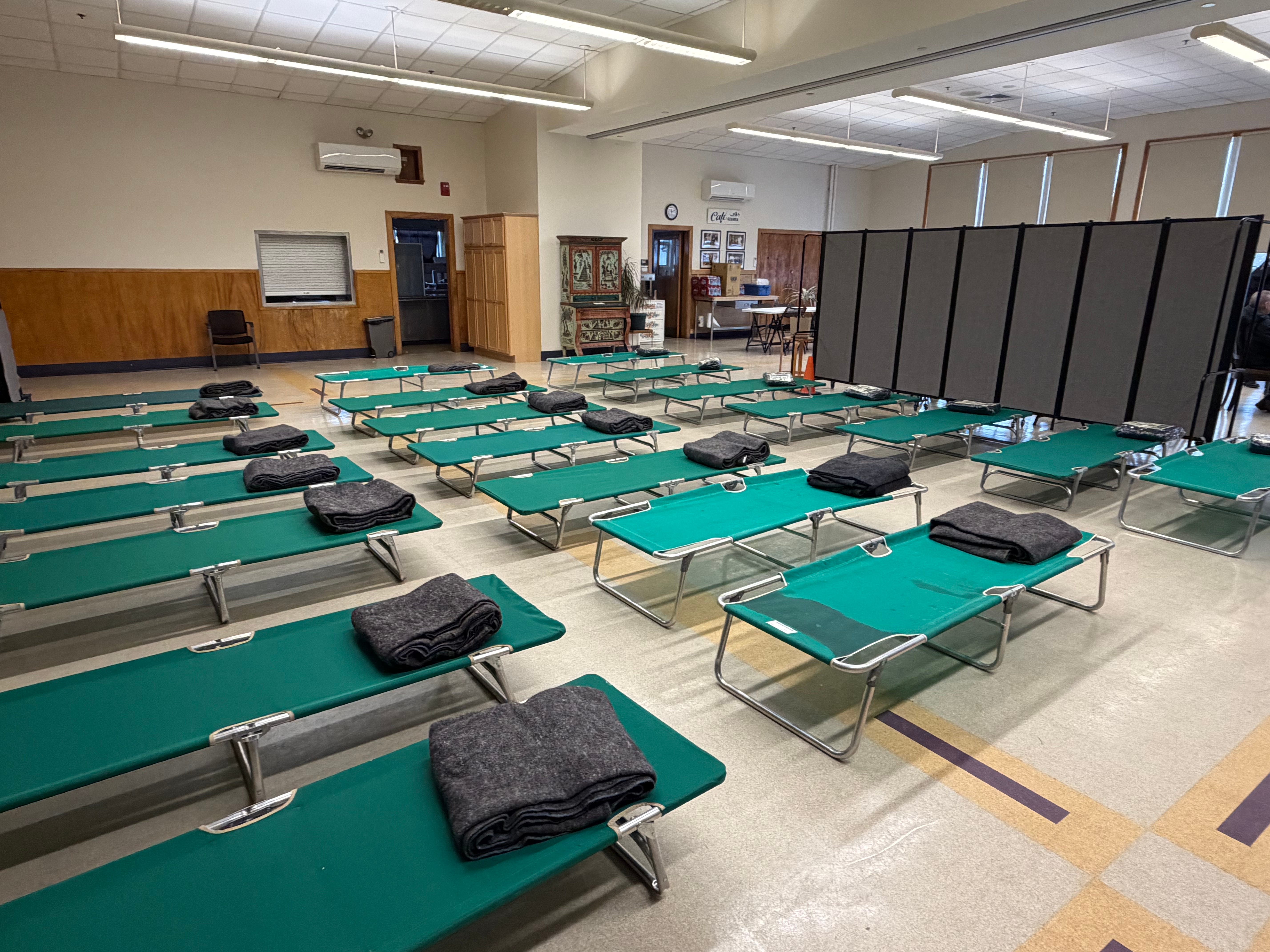
In the days leading up to the storm, we had done what we are supposed to do. Internal coordination meetings. County calls. Pre-staging approximately twenty cots, blankets, bottled water, and charging stations at our emergency shelter location at the Veteran’s Memorial Community Center (VMCC). On paper, we were prepared.
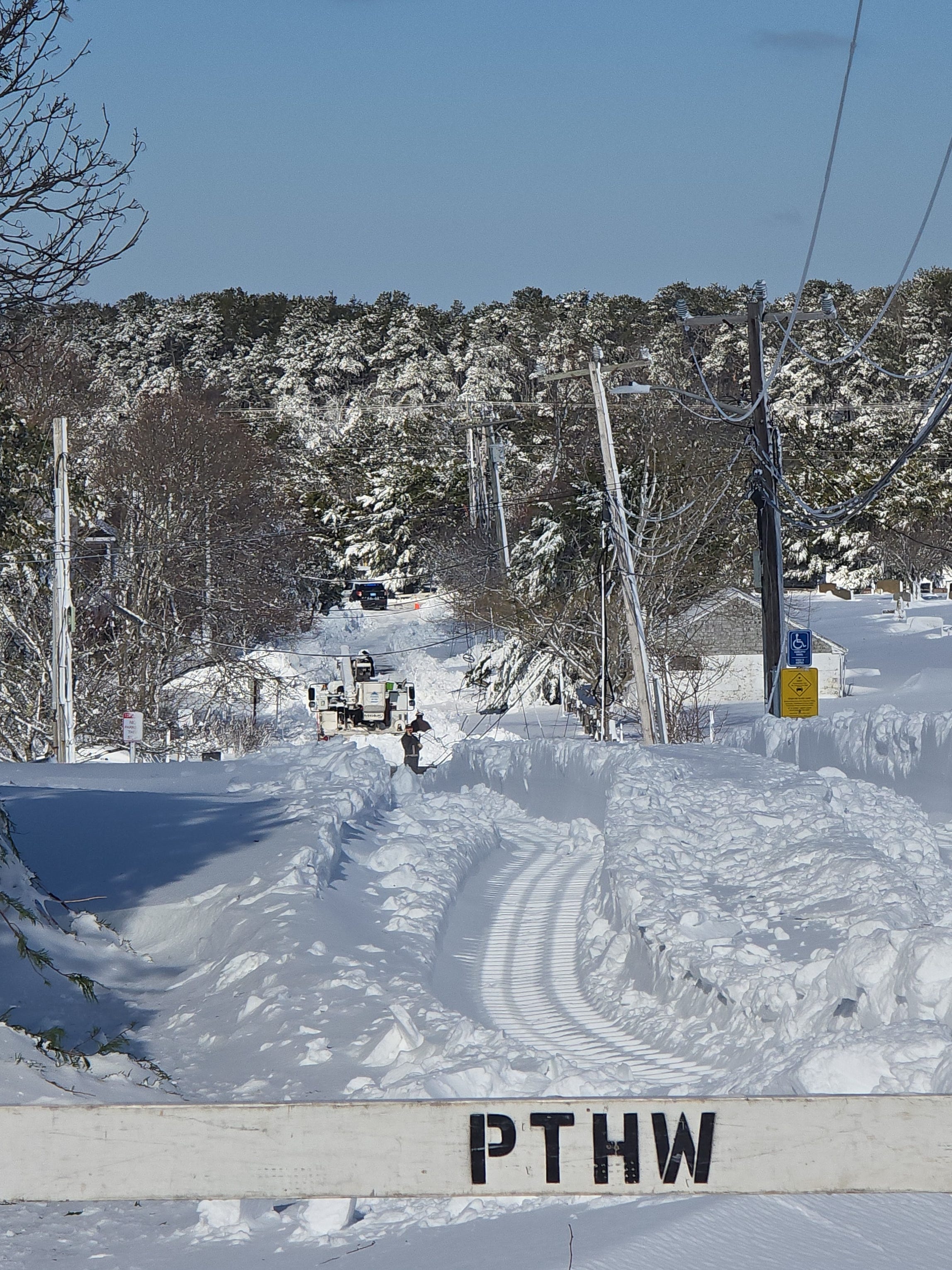
But paper preparation does not account for the road to your pre-designated emergency shelter being impassable due to downed poles and white-out conditions. And it certainly does not account for your backup shelter location at Town Hall losing generator power almost immediately after the storm starts.
Emergency management best practices emphasize that residents should be prepared to shelter in place for the first 12–24 hours of an event like this, and that guidance is sound. With power having only gone out in the early morning hours on Monday, we knew that most residents could safely remain in their homes for several hours. But as reports continued to come in — the ongoing blizzard, the extent of the infrastructure damage, the freezing temperatures, the likelihood of multi-day restoration — it became clear that we would need to open the shelter.
The question was not whether we had to do it. It was when and how.
1:00 p.m. Monday
By early afternoon, nearly every system we rely on was either compromised or unreliable. Power was out. Internet was out. Cell service was intermittent. Police and Fire radio communications were unstable. Roads were barely passable, even for plows and emergency vehicles.
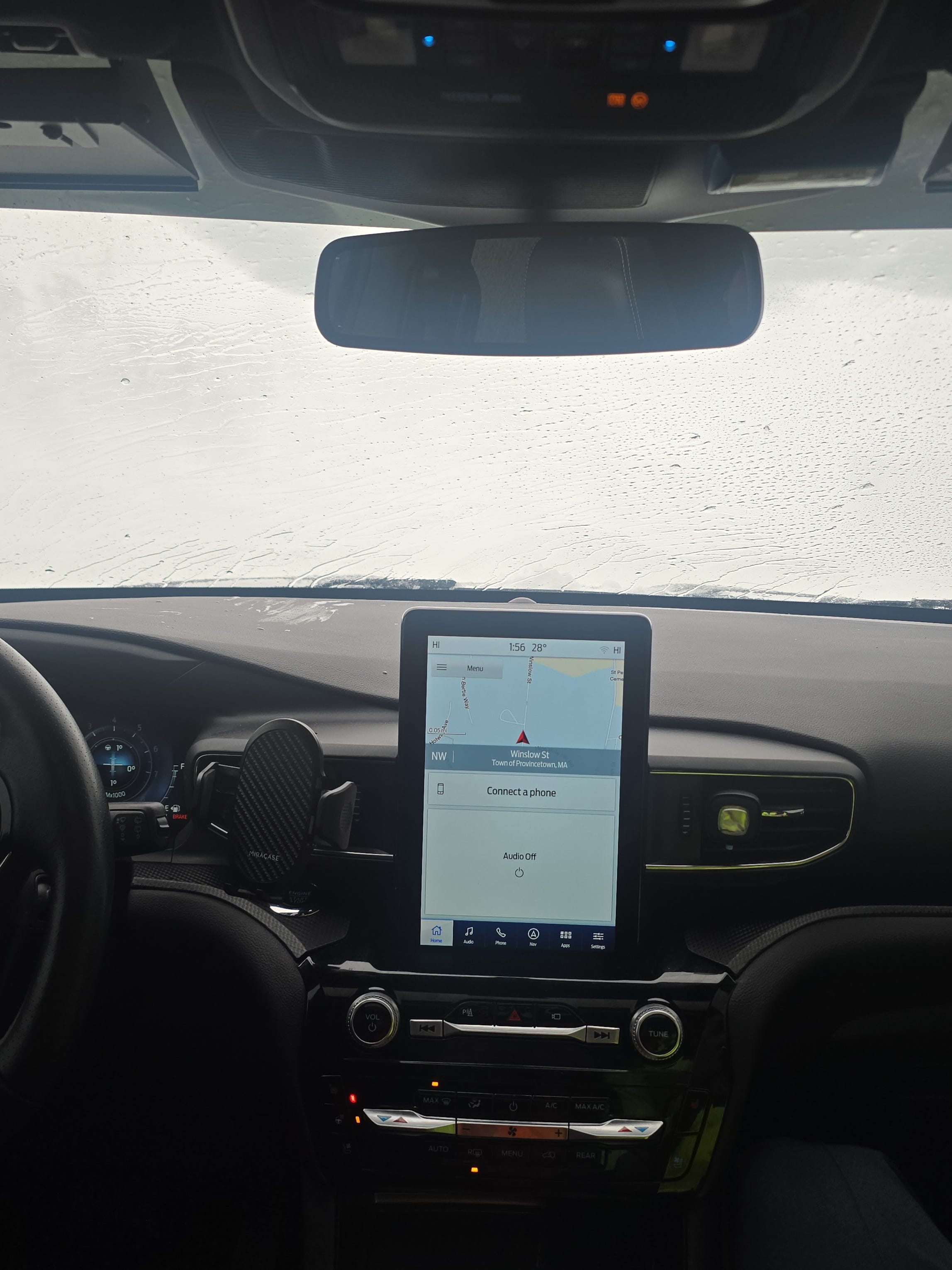
There are two primary ways to access the VMCC on Winslow St. One was rendered completely impassable due to multiple downed poles and power lines. The other route could technically be plowed, but snow drifts were reforming almost immediately after each pass, undoing DPW’s hard work within minutes.
DPW crews went back out repeatedly anyway, which is something I don’t think most people fully appreciate — the sheer physical effort of clearing the same stretch of road over and over again simply to create a narrow window of access so that we could get access to the building.
We announced the shelter would open at 7:00 p.m., knowing that was later than we had hoped but realizing we needed more time for crews to clear the way so staff could physically get to, and open, the shelter.
7:00 p.m. Monday
When the doors opened at the VMCC, we genuinely did not know how many people would come. We estimated perhaps twenty.
They came steadily at first, and then more quickly.
Some walked through the storm. Many were transported by Provincetown Police and Fire because driving conditions made traveling there unrealistic and unsafe. Truro Fire transported a fair number of Truro residents in as well, underscoring the regional nature of the crisis.
We were signing people in — name, address, phone number — and guiding them to cots that had been arranged in the Council on Aging multi-purpose room. There was a palpable mixture of fear, uncertainty, and relief. People were understandably anxious about how long they would be away from their homes, whether their pipes would freeze, whether their power would return overnight.
We did not have definitive answers.
Many of the individuals arriving later that evening had complex medical or mobility needs, and the effort required to extract them from their homes was significant. Police officers and firefighters shoveled paths, navigated drifts, and in several instances physically carried residents out of their houses and into transport vehicles.
10:00 p.m. Monday
By 10:00 p.m., we had decided it was time for “lights out” in the main room, but transports continued.
By approximately 1:00 a.m., we had checked in and sheltered around forty individuals and had expanded into the yoga room to accommodate overflow.
It was organized, but it was tight, and we began to recognize this was likely only the beginning.
7:00 a.m. Tuesday, February 24
The next morning began with something that sounds trivial: we could not get the coffee maker to work.
But in a shelter environment — especially one that may operate for multiple days — those small routines matter disproportionately. Coffee is comfort. Coffee is normalcy. Coffee is the difference between “this is unbearable” and “this is manageable.”
We boiled water for tea instead.
Stop & Shop, despite having no power, allowed Town staff inside to gather breakfast pastries. That gesture — that willingness to help even while their own systems were down — was deeply appreciated.
This was also the moment where the tone and focus of our efforts began to shift. With the Council on Aging Director on site, we moved from pure emergency triage toward something more deliberate — toward care. We began thinking not just about how to house people, but how to sustain them physically and emotionally over an extended period.
9:00 a.m. Tuesday
By 9:00 a.m., it was becoming increasingly clear that whatever we had told ourselves the night before about this potentially being short-lived was no longer realistic. The early optimism that power might return in large portions of town overnight had faded, replaced by more detailed updates about the extent of the infrastructure damage and the number of poles and lines that would need to be repaired before meaningful restoration could occur.
That realization shifts your mindset in a very particular way. You stop thinking in terms of “How do we get through tonight?” and start thinking in terms of “How do we sustain this for days?”
I called a meeting with Police, Fire, and DPW leadership because the configuration that got us through Monday night — while admirable — was not designed for duration. We were operating out of multiple small rooms inside the VMCC, cots tucked into whatever space we could find, staff stretched thin and improvising constantly. It worked for twelve hours. It would not work for seventy-two.
The conversations were candid. There was frustration expressed. But what emerged from that meeting was a clear directive: If we were going to do this well, we needed to centralize overnight sheltering, formalize roles, and build something that felt less improvised and more sustainable. We needed structure that could hold under pressure, not just react to it.
That was the moment we stopped thinking of the shelter as a temporary fix and started thinking of it as a sustained operation.
12:00 p.m. Tuesday
By noon, lunch arrived — thanks to Liz Lovati of Angel Foods and Paul Fanizzi of Fanizzi’s — who had coordinated to provide food not just for the shelter residents, but for the staff who had been working around the clock. And this wasn’t a box of generic sandwiches dropped at the door. It was thoughtful. There were options. Vegan and gluten-free meals for those who needed them. Real food, prepared with care, under circumstances that were hardly convenient for the businesses providing it.
There’s something important about that distinction. In an emergency, you can feed people. Or you can care for them. The difference isn’t just nutritional — it’s emotional. When someone receives a meal that clearly required thought and effort, it communicates that they are not just being managed, but they are being valued.
Inside the VMCC, the mood softened as lunch was served. People who had arrived anxious the night before were sitting together, eating, talking. Staff were able to pause for a few minutes and eat something substantial. It was the first moment that day where things felt, if not stable, then at least grounded.
At the same time, we were already planning the move to the gym and the operational expansion that would follow. Lunch was not a pause in the work — it was fuel for the next phase. Because by noon Tuesday, we understood that this wasn’t just about getting people through a stormy night. It was about building an environment that could function safely, calmly, and humanely for as long as it needed to.
3:00 p.m. Tuesday
By mid-afternoon, we were operationalizing the move into the gym. Sections were established for elderly and medically fragile residents, for families, and for those with pets. Police developed a more comprehensive intake form so we better understood who was in our care and what their needs might be.
I had made the conscious decision to remain embedded in the building each day. You cannot effectively oversee an operation like this from a conference room across town. You have to see what is happening in real time — the mood shifts, the pressure points, the people you see who might be struggling but not vocalizing it.
4:00 p.m. Tuesday
By 4:00 p.m., we had just begun to feel like we were getting our arms around the new operational plan — centralizing overnight sheltering in the gym, organizing sections, tightening intake, assigning clearer staffing roles — when two National Guard units arrived in town unannounced.
There is a particular kind of mental shift that happens when that occurs. On the one hand, you’re grateful for the additional manpower. On the other hand, you now have to figure out, in real time, how to meaningfully deploy them without disrupting the fragile structure you’ve just built.
We moved quickly. They began assembling additional cots, helping define sleeping sections inside the gym, assisting with setup that would have taken our already-exhausted staff hours longer to complete. The physical presence of uniformed Guard members inside the building also subtly shifted the atmosphere. It signaled scale. It reminded everyone — residents and staff alike — that this storm was larger than our building and that broader systems were mobilizing.
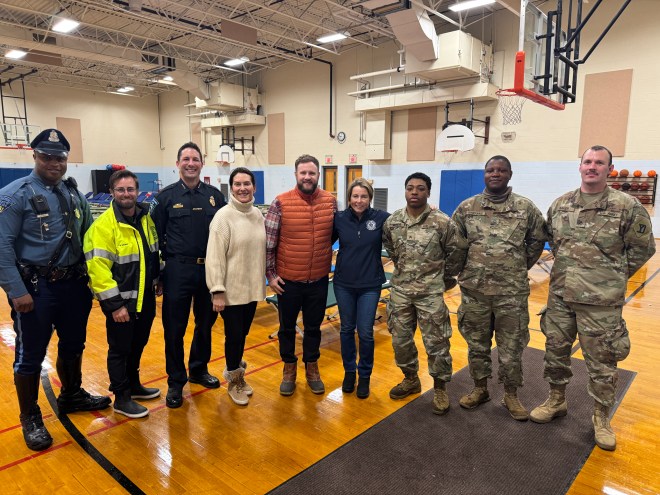
And then, almost immediately after that, we received minimal notice that the Governor would be visiting the shelter.
Operationally, this was complicated. We were mid-transition. Residents were still in the VMCC spaces. The gym was not fully configured. Staff were tired. I had not been home since Monday morning.
So I left briefly — driven back to my house by the Police Chief, which still had no power and no heat — and tried to make myself presentable in a freezing bathroom without hot water. It was a quick reset. A change of clothes. A mental recalibration. And then back to the shelter.
There is a strange duality in moments like that — toggling between emergency operations and the optics and logistics of a gubernatorial visit — all while the storm’s impacts were still unfolding around us.
5:30 p.m. Tuesday
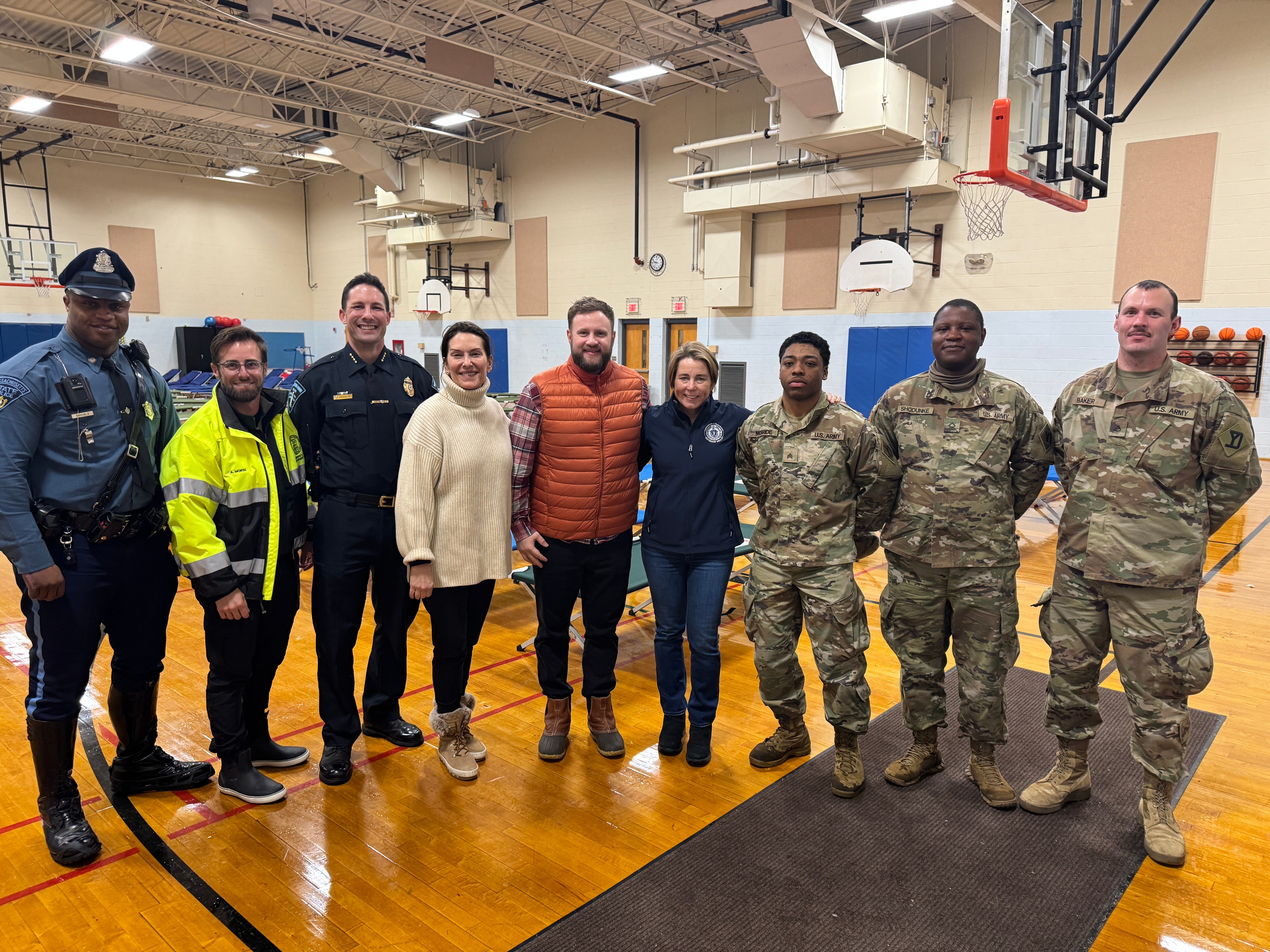
By 5:30 p.m., I was back at the VMCC, and we were preparing for the Governor, along with our State Senator and Representative. The gym was partially configured. The cots were lined up. Sections were forming. Staff were still moving equipment and organizing supplies.
We gave them a tour of the space, explained the transition plan from the Council on Aging area to the gym, walked through intake procedures, and updated them on the broader situation in town — the outages, the infrastructure damage, the challenges of access and restoration. It was a compressed briefing in the middle of an active operation.
There is no denying that the visit required time and attention that took us away from our shelter operations. It also introduced political and optics issues that we then had to manage afterward. But having our Governor and state representatives there was an extremely valuable opportunity — not only for the Town and its staff, but for the residents who hadn’t had any good news in about 36 hours.
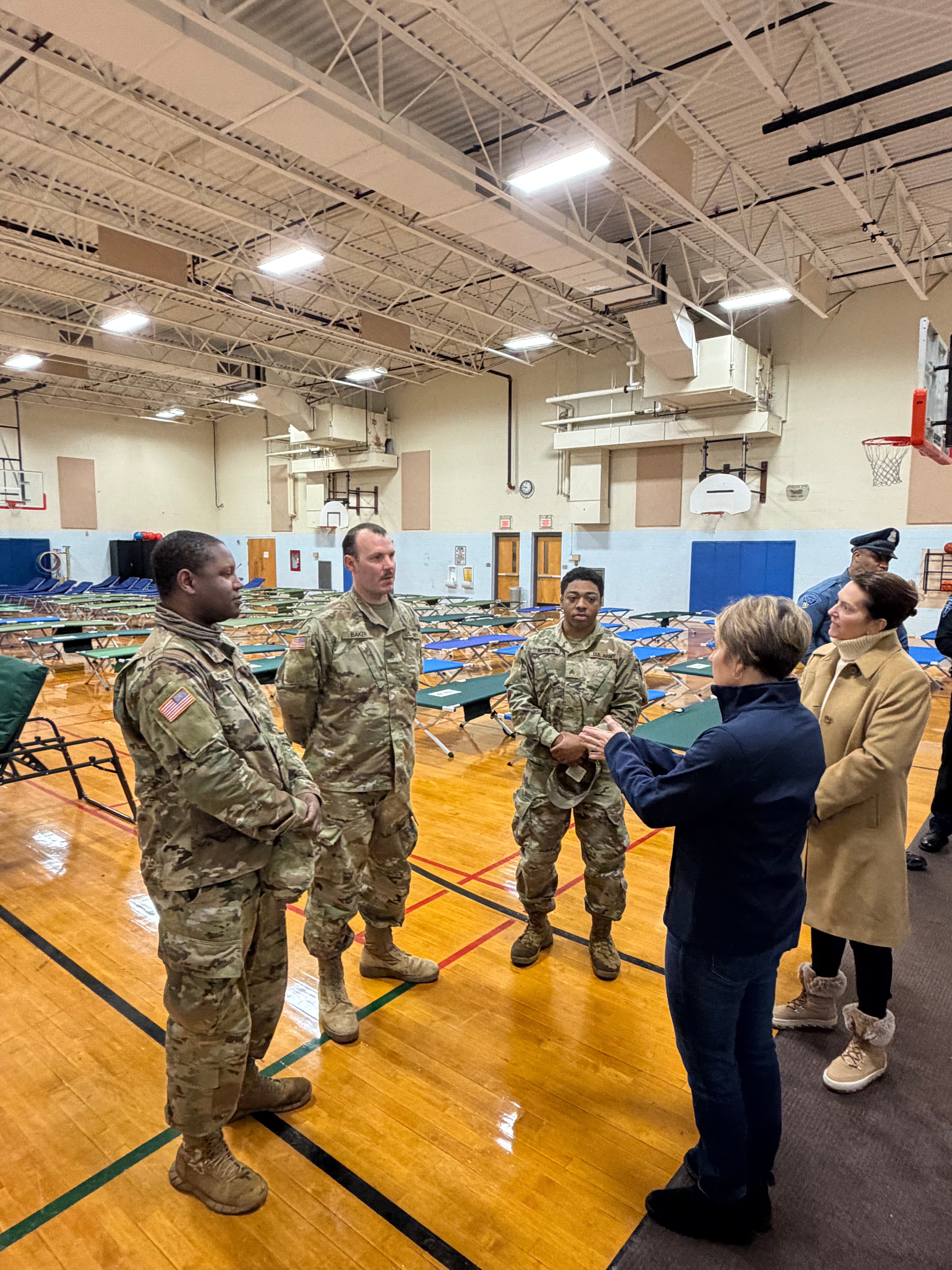
When the Governor moved through the VMCC and spoke directly with residents for over 30 minutes — asking them how they were doing, thanking staff, acknowledging the strain, bringing joy while holding a smiling 6-month-old girl who was staying there — something shifted in the room.
For more than 24 hours, we had been in pure crisis mode. Staff were running on adrenaline and obligation. Residents were living in uncertainty. The Governor’s presence created a brief, but meaningful, pause. People stood a little taller. Staff felt recognized. Residents felt visible.
Whatever complexities the visit created behind the scenes, the morale boost inside that building was real.
And then, as quickly as it began, it ended — and we returned to the work of moving sixty people and all of their belongings from one temporary home to another inside a school gym while the power across town remained out.
7:00 p.m. Tuesday
After the visit, we began the delicate work of transitioning residents from the VMCC space to the gym for overnight sheltering.
Staff walked cot to cot, explaining the reasoning, answering questions, and helping everyone complete our new intake forms.
We served dinner and prepared for what would be our largest overnight population — approximately sixty residents.
10:00 p.m. Tuesday
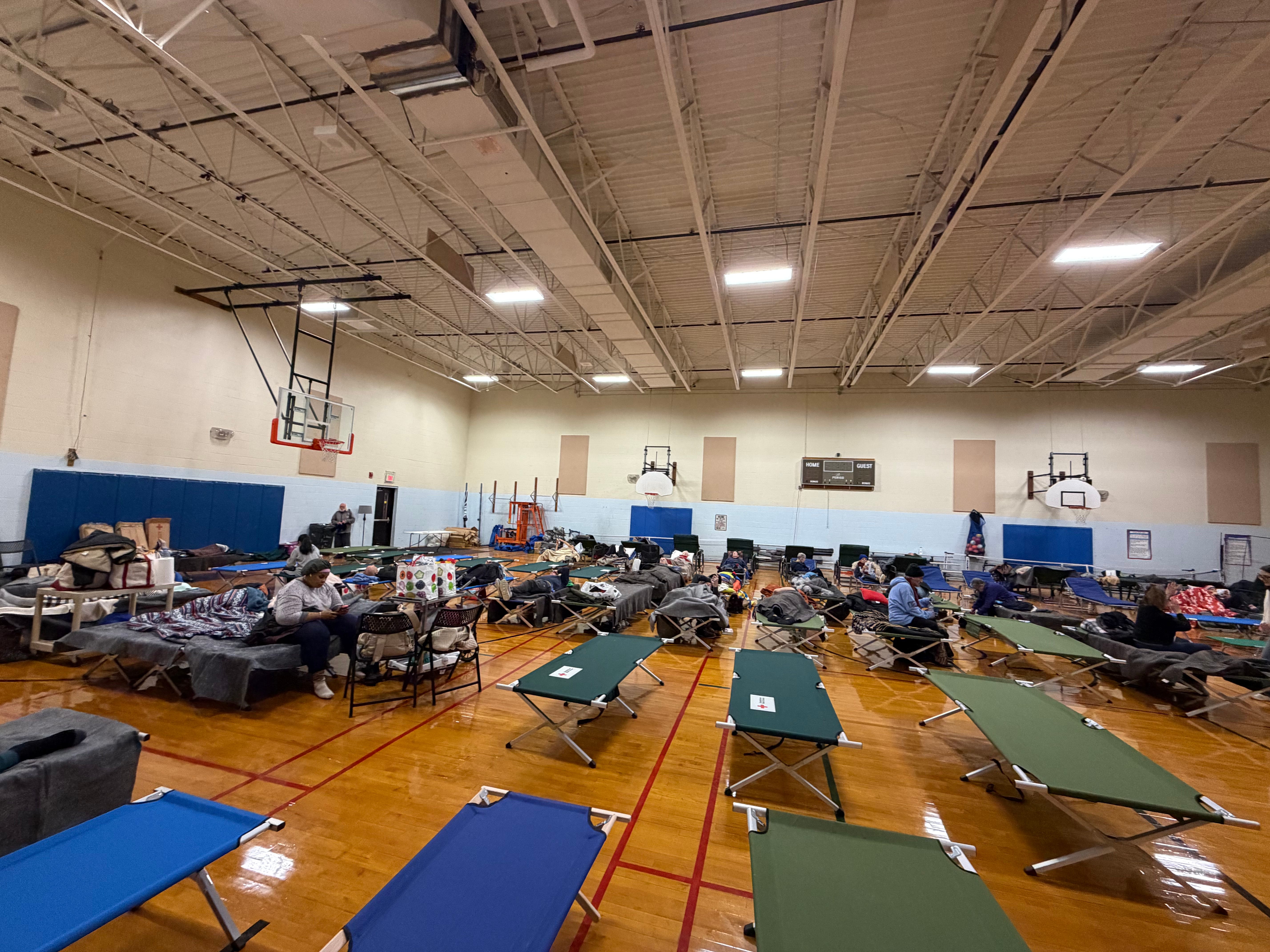
A little after 10:00 p.m., it was lights out in the gym and the second overnight in what had become a very different operation began.
Getting to that moment had required an extraordinary amount of coordination in just a few short hours. After dinner, staff had moved deliberately from cot to cot, helping residents gather their belongings — blankets, bags, medications, phone chargers, pet supplies — and walk the long hallway from the VMCC into the gym. It sounds simple when written down, but moving sixty people, many with mobility challenges, some with pets, some understandably anxious about yet another change in environment, is not a small undertaking.
There is always a delicate balance in those moments between efficiency and empathy. We needed to execute the move cleanly and safely, but we also needed to acknowledge that, for the people in our care, this was their temporary home. Moving again meant another adjustment and another moment of uncertainty.
Inside the gym, the layout now felt intentional. Cots were organized in defined sections. Elderly residents and those with medical needs were positioned in areas that allowed for easier access by staff. Pets and their owners were consolidated into their own section as to not interfere with others.
For the first time since Monday night, the overnight structure felt stable.
We had established a clear chain of responsibility: a Police OIC (Officer in Charge) inside the gym overnight, a Community Service Officer assisting, and an EMT from the Fire Department present for any medical issues that may arise at a moment’s notice. That structure allowed civilian Town staff — who had been operating nearly continuously — to step away for a few hours of rest.
And that, in many ways, was one of the most important shifts of the week.
Up until that point, the shelter had felt fragile — dependent on a small group of people holding it together moment by moment. By Tuesday night, it felt institutionalized. Not in a cold way, but in a secure way. The systems were in place, roles were defined, and the physical space was designed for the purpose it was now serving.
We were no longer just reacting to a storm. We were running a human-centered shelter.
7:00 a.m. Wednesday, February 25
Lights on in the gym.
We had secured a working coffee maker, which sounds minor but, after not being able to serve coffee Tuesday morning, it felt like a genuine victory. Coffee was brewing. Hot water was ready. Breakfast pastries were set out. Staff were helping people move between the gym and the VMCC to transition for the day.
Overnight, a decent portion of town had regained power, and for the first time since Monday, there was cautious optimism in the air. Residents were asking, “Do you think today might be the day?” Staff were quietly checking outage maps and waiting on updates from Eversource.
There was a sense that maybe this could begin winding down.
9:00 a.m. Wednesday
Then a main electrical pole serving town snapped and the power that had just come back on a few hours ago went back out again.
You could feel the shift in the building almost immediately. It wasn’t dramatic, but it was real. The conversations changed tone. The optimism narrowed. Staff who had been tentatively planning for demobilization recalibrated in their heads.
It’s one thing to tell people to prepare for multi-day outages. It’s another to have hope briefly restored and then taken away.
We knew at that point this was not ending that day.
12:00 p.m. Wednesday
By midday Wednesday we were deep into sustained operations.
Liz and Paul delivered sandwiches again, but they were now effectively tapped out until their power and deliveries were restored.
Inside the VMCC, the atmosphere was increasingly frenetic. We had approximately 50 overnight shelter residents still in our care and, in addition, another 50-100 people coming in and out throughout the day to warm up, charge devices, socialize, and gather information.
The warming/charging station had become its own ecosystem. People were clustered around outlets. Others were sitting around talking, processing, venting. Some were just grateful to be in a lit, heated space with other people for the first time in days.
More Town staff began showing up organically — not because they were scheduled, but because they wanted to help and, in many cases, didn’t have power at home themselves. While the instinct to help was appreciated and deeply reflective of this community, it also created logistical challenges. Unstructured support can unintentionally create duplication, confusion, or missed needs. We had to tighten coordination without discouraging the generosity that was showing up at the door.
All of this was happening while we were facing diminishing food supplies.
3:00 p.m. Wednesday
By mid-afternoon, the weight of it hit me.
We were running out of food. I did not know how I was going to feed our overnight residents dinner, let alone feed staff and the additional 50+ people who were there charging. We were now on day three without power in much of town, and the fatigue was cumulative — not just physical, but cognitive.
I was completely drained.
There’s a particular strain that comes from being responsible for both the operational logistics and the emotional tone of a space, as well as the public communications to the rest of our residents outside the shelter at home, in the cold, growing increasing frustrated with their situation. You’re thinking about intake forms, security, medical needs, staffing, meal planning, Eversource progress, public alerts and social media updates — and at the same time you’re absorbing residents’ anxiety, staff exhaustion, everyone’s questions, and the ambient stress of an entire town in crisis.
I pulled several staff into a room and had an honest conversation about how I was feeling — not theatrically, but candidly. I told them I was overwhelmed. That we needed to tighten the structure. That I needed help problem-solving in that moment.
We regrouped. We formalized civilian staff shifts with clearer roles and expectations to reduce the freelancing that had organically developed. We reached out to the County and made it clear that we needed food support not just for dinner, but for sustainability.
That reset — operationally and emotionally — mattered.
6:00 p.m. Wednesday
The Family Table Collaborative came through in a significant way, coordinated through the County, and delivered what would become the first hot meal many residents had had since the storm began.
When we began serving dinner, you could feel the release in the room. Hot food changes the emotional temperature of a space. It signals stability. It signals care. It signals that someone is thinking ahead.
People were not just fed — they were relieved.
An unannounced food delivery arrived via AmeriCorps later that evening, providing enough supplies for breakfast, lunch, and dinner moving forward. For the first time in days, I felt something that had been in short supply: confidence that we could sustain this operation without scrambling meal to meal.
10:00 p.m. Wednesday
As the evening wound down, overnight shelter residents transitioned back into the gym — about 30 remained with us that night. The overall number had decreased slightly, but the core group was still steady.
By this point, the overnight routine was established. Police OIC in place. CSO present. EMT on site. Lights out at 10:00 p.m. The structure had matured from reactive to intentional.
7:00 a.m. Thursday, February 26
Lights on. Coffee ready.
By Thursday morning, there was a noticeable difference in tone compared to Wednesday. Eversource crews were making measurable progress. We were getting more consistent updates. Pockets of town were coming back online.
Residents were cautiously optimistic again, but this time with a bit more restraint.
Inside the building, the rhythm was steady. Breakfast. Coffee. Quiet conversations. Some residents preferred to stay in the gym due to mobility limitations, so we prepared food carts and brought coffee and breakfast directly to them rather than requiring them to navigate the hallway.
This attention to detail — not just operating efficiently, but thoughtfully — had become part of the culture of the shelter.
12:00 p.m. Thursday
Lunch arrived from Box Lunch in Truro — sandwiches and COOKIES!
Card games had taken over several tables. Laughter and good-natured ribbing could be heard. Conversations about whose power had returned and whose hadn’t.
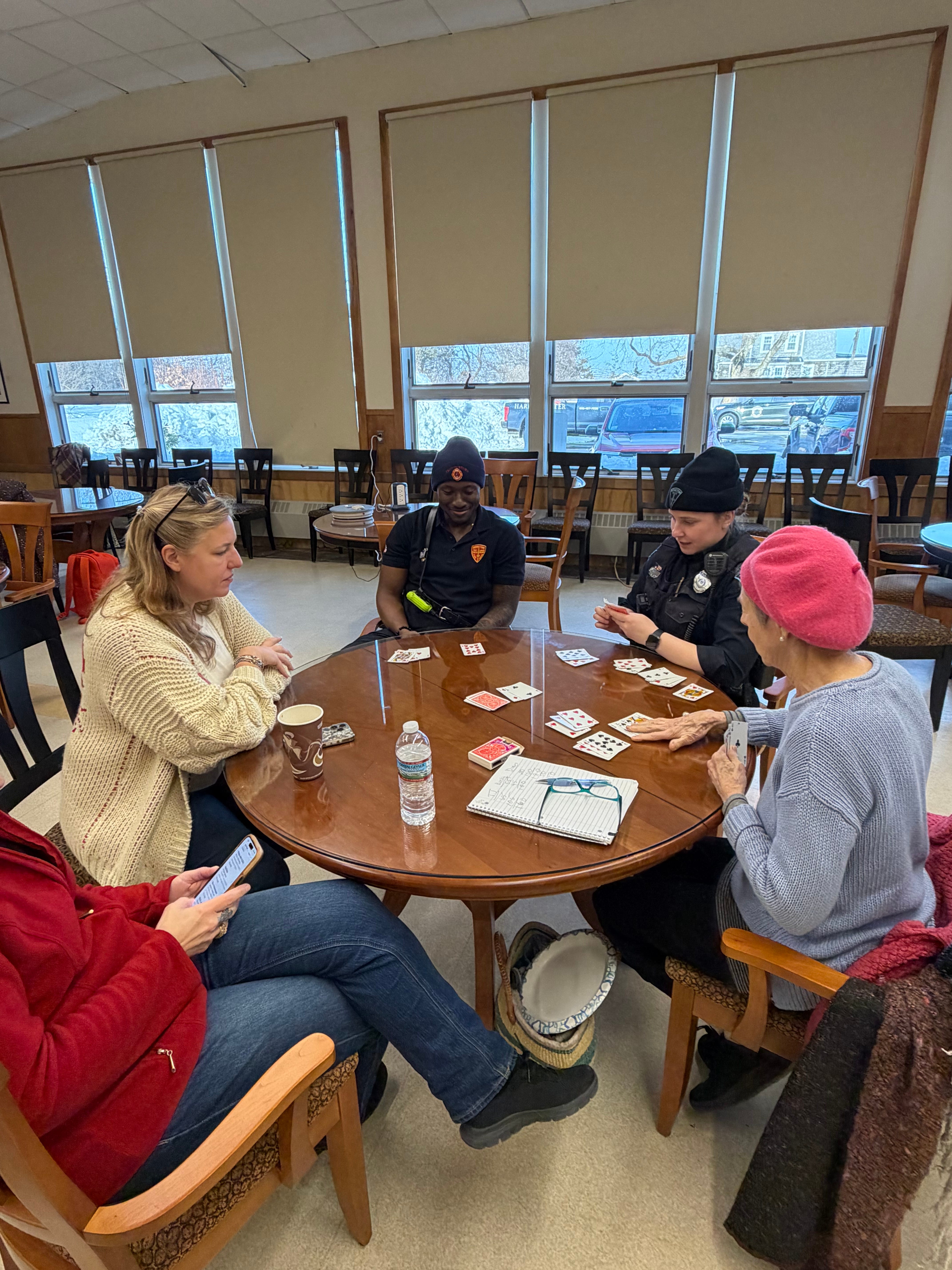
Many homes were coming back online, and we began transporting residents home using the Council on Aging van. Each departure felt both celebratory and bittersweet. People and staff had formed bonds.
This had become more than a shelter.
6:00 p.m. Thursday
And now an MCI (Mass Casualty Incident) occurred at the Pier involving carbon monoxide exposure. Two individuals and several public safety personnel along with our Harbormaster, were transported to Cape Cod Hospital.
Even in the final stretch, we were reminded that emergency management rarely allows you to focus on just one thing at a time. Resources were stretched thin again and our attention divided to another crisis.
Despite that, based on restoration progress and the decreasing number of residents at the overnight shelter, we made the decision that the shelter would begin to wind down with the goal of closing at noon on Friday. We began carefully messaging that to residents, working individually with anyone who still lacked power to ensure they had a safe plan.
10:00 p.m. Thursday
Approximately 13 residents remained overnight. Some had power restored but chose to stay one additional night to confirm stability and allow their homes to warm up — an entirely reasonable decision given what the week had looked like.
The gym was quieter now. More space between cots. A calmer energy.
7:00 a.m. Friday, February 27
Coffee, tea, fruit, yogurt, oat crisp — a calm, anticipatory morning.
Police and Town staff drove around town to physically confirm power restoration at specific addresses before we transported residents home. We were not operating on assumptions, we were verifying, as there is something profoundly important about closing a shelter carefully rather than quickly.
9:00 a.m. Friday
We began saying our goodbyes. Hugs were exchanged. People who had arrived anxious and uncertain were leaving steadier and grateful for the experience.
Two residents still lacked power, and we worked through individual action plans for each.
11:00 a.m. Friday
The Pilgrim House donated a room for one elderly resident who remained without power. Within hours, his electricity was restored, and Police transported him home safely.
It was a small moment in the broader scope of the week, but it captured something essential about Provincetown — the instinct to step in.
12:00 p.m. Friday
No residents remained and the VMCC Shelter officially closed.
Town staff went home to rest after an extraordinary week.
Over the course of the storm, 73 individuals were housed overnight for one night or more nights at our shelter. Ages ranged from just six months old to 89 years old, with a median age of approximately 71 — a stark reminder that the shelter was serving a population that skewed heavily older. More than half of those staying with us, 42 individuals or roughly 58 percent, reported medical conditions or reliance on medical devices, including oxygen, CPAP machines, cardiac conditions, diabetes, stroke history, Parkinson’s disease, and mobility limitations.
In total, we provided services to approximately 300 people, with many who were in our care, 24/7, for up to five days.
What People Don’t See
What people understandably don’t see — because it’s not the part that makes it into the storm alerts or shelter updates — is what it felt like for the staff running that shelter on a personal level.
Many of the people working 12, 14, 16, 24-hour stretches inside that building were going home (if they were going home at all), to houses without power and heat and hot water. Some had children sleeping under extra blankets. Some had spouses trying to manage the household in the dark. Some had elderly parents sitting in cold living rooms of their own.
And yet every day, they showed up and spent their time caring for other people’s parents and grandparents. They were helping other families stabilize while knowing their own families were uncomfortable, and in many cases very worried. They were making sure someone else had a warm meal while their own child was navigating a cold house.
There is something uniquely heavy about that dynamic — about choosing, in real time, to prioritize the broader community over the comfort of your own family — and doing so without complaint.
That emotional toll doesn’t get captured in an after-action report. But it is real.
The week was physically exhausting, yes — but it was also emotionally draining and psychologically demanding in a way that lingers. You’re not just moving cots and coordinating meals. You’re absorbing stress. You’re holding space for fear. You’re carrying responsibility around the clock.
And still, no one gave up.
We stayed. We adapted. We carried it. We kept moving.
Facts and Frustrations
Were the first few hours of the storm and the shelter chaotic? Of course they were, and I’m realizing now that that is to be expected. No amount of preparation can really prevent it. And anyone who has been in a situation like this and says otherwise isn’t being honest.
We were dealing with cascading system failures, limited access to facilities, incomplete information, and a storm that was still actively causing damage while we were trying to respond to it. Plans that looked sound in advance bent under pressure. Some cracked entirely and had to be rebuilt mid-event.
But bending and rebuilding during a live emergency is not failure. It is what adaptation looks like in real time.
Once the shelter opened, it never closed. Not when staffing was stretched. Not when food was tight. Not when people were exhausted. And we did not turn a single person away who came to us for help.
For five straight days, Provincetown — with all of our geographic constraints and limited resources — opened, staffed, and maintained our own municipal shelter. To my knowledge, we were the only town on the Cape that did so in that way, at that scale, for that duration.
I understand the frustration that showed up on social media. People were cold. They were scared. They were sitting in dark homes waiting for a private utility company to restore power, and that waiting is incredibly difficult. When you’re uncomfortable and anxious, it’s natural to direct that frustration somewhere.
There is also something fundamentally different about observing an emergency response from the outside versus carrying the weight of decision-making from within it.
It is easy — and entirely human — to second-guess choices on social media, to suggest alternative timelines, different messaging, or different thresholds for action. It is much harder to sit in a room where every decision has real-time consequences for real people, where information is incomplete, systems are failing, and the margin for error is thin.
Each call we made — when to open, how to structure intake, where to allocate staff, how to message safety without creating panic — carried responsibility. Not theoretical responsibility, but immediate responsibility. The kind where if you get it wrong, someone feels it that night. There is a weight to that which doesn’t translate into Facebook comments.
But it’s also important to separate the weather and the utility company from the Town and its staff working out on the streets in the storm and inside the building operating the shelter.
The Town is not the storm. The Town is not Eversource.
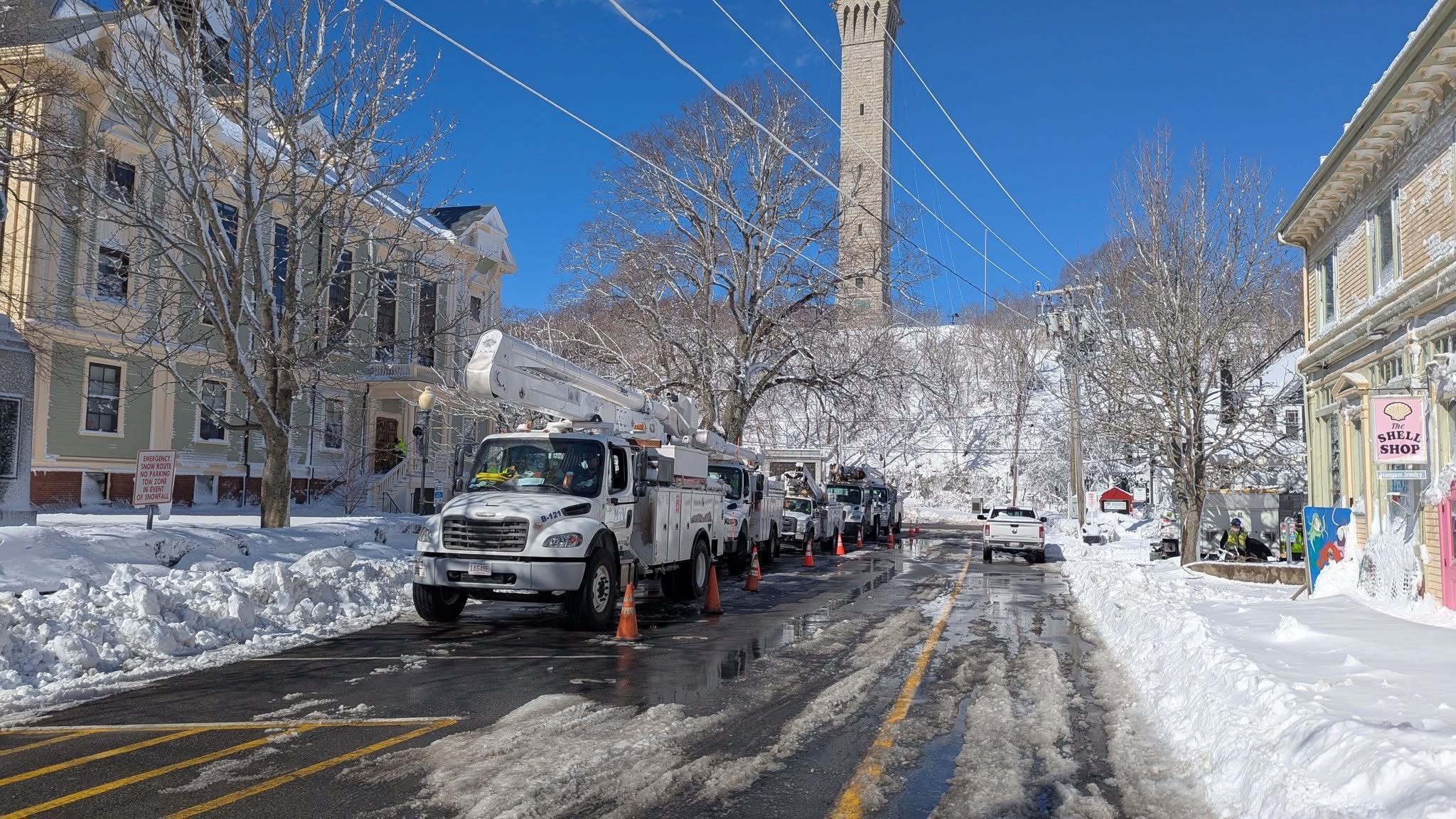
The Town was the police officers carrying residents through snow drifts to waiting vehicles. It was fire and EMS staff responding to transformer fires and continually checking in on the medical needs of those in the shelter. It was DPW crews driving through the worst of the storm, clearing the same roads repeatedly, and working overnight at the shelter to clean the facility so those staying there had a dignified place to wake up to each day. It was Council on Aging staff preparing meals and checking in on individuals’ specific needs, having conversations, and grounding us in the human services work that needed to be done. It was countless other Town staff who volunteered their time at the shelter to do whatever was needed in the moment knowing they wouldn’t be getting overtime pay.
If you want to know what Provincetown looks like under pressure, it looks like that. It looks like selflessness. It looks like collaboration. It looks like exhaustion paired with determination. It looks like people quietly doing what needs to be done without asking for recognition.
What This Changes Going Forward
If there’s one thing this week did beyond testing us, it fundamentally reshaped how we think about our emergency management planning.
Plans written in advance are necessary — but they are theoretical. What we built inside the VMCC and the gym over those five days was tested in real conditions: limited access, communication failures, staffing strain, food insecurity, public scrutiny, and prolonged outages. That lived experience is far more instructive than any tabletop exercise.
We learned that centralization is not optional — it’s essential. One location. One intake system. One overnight command structure. Trying to split warming, sheltering, and charging across multiple facilities would have stretched us beyond capacity and diluted oversight. Going forward, that principle will be embedded in our planning.
We learned that leadership must be embedded on site. You cannot effectively manage a shelter remotely. Real-time presence allows for real-time adjustment, and that flexibility is what carried us through the moments when the plan bent.
We learned that staffing needs to be structured early — clear shifts, defined roles, disciplined coordination — while still allowing space for the organic generosity that shows up in a small town during a crisis.
And perhaps most importantly, we learned that the culture of a shelter matters just as much as the logistics.
The final operational setup we implemented will be our template moving forward. So when the next storm comes, we will be building from something that was pressure-tested in real time.
Emergency management plans are often written as static documents. What this storm gave us was something more valuable: a lived blueprint.
An Immense Sense of Gratitude
Blizzard Hernando tested our town, its systems, and our people in ways that were real and immediate.
We bent. We adjusted. We rebuilt.
We reached out for help from local businesses who stepped up to provide food, open their doors to the public as other options of places to stay warm and connected, and offered shelter for folks in need.
I am so grateful to all of the Town staff who were working throughout the storm to keep roads clear, the community safe, and provide services at the shelter. There are too many to name – but they know who they are – and they will be thanked individually for their extraordinary efforts.
I’m also grateful to the over 300 people who came to us for help. The trust they placed in us to help them weather this physical, psychological, and emotional storm, is no small thing. Imagine spending two or three or five days living in close quarters with many strangers — their personalities forced to intermingle and coexist through the most difficult of situations. Our residents were remarkably resilient, gracious, kind, and appreciative.
Through it all — the wind, the snow, the outages, the uncertainty — what we built was not just a shelter.
We built something together that was deliberate, thoughtful, humane, and something I am genuinely and deeply proud of: we built a community within a community that operated not just on survival, but on care.
 Riviello Communications